
 Admin
Admin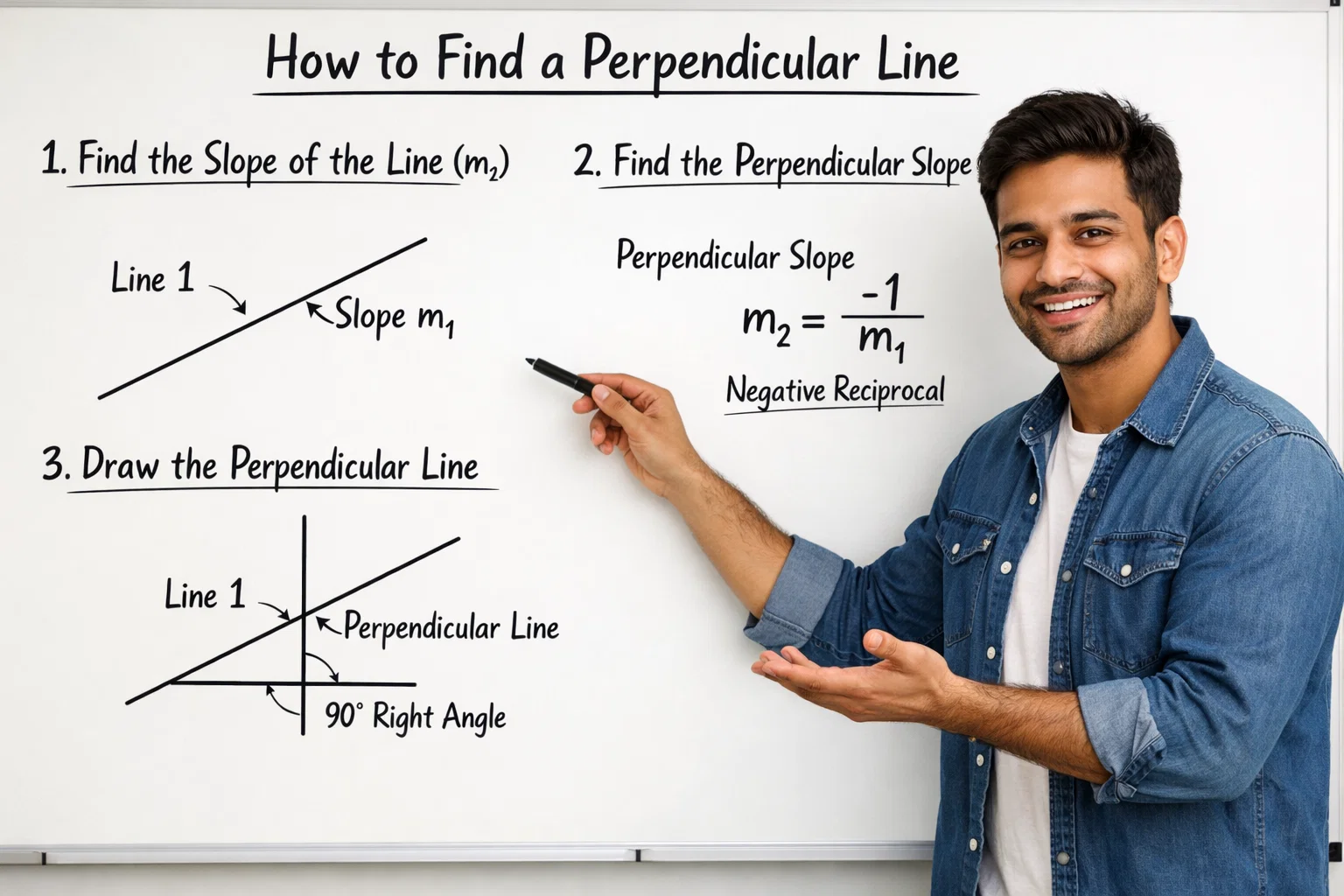
Understanding how to find a perpendicular line is one of the most essential skills in mathematics, especially in algebra, geometry, engineering, and physics. Perpendicular lines are everywhere in real life, from the corners of buildings to road intersections and computer graphics. They meet at exactly 90 degrees, forming what is known as a right angle, which ensures structural balance and accuracy. Learning this concept not only improves mathematical ability but also strengthens logical thinking and problem-solving skills. Whether you are a student preparing for exams or someone curious about geometry, mastering this topic will help you understand coordinate systems, slopes, and spatial relationships with clarity and confidence.
Understanding Perpendicular Lines in Geometry
Perpendicular lines are defined as two lines that intersect and form a right angle of exactly 90 degrees. This concept dates back over 2,300 years, when the Greek mathematician Euclid described perpendicular lines in his famous work on geometry. His principles established the foundation of modern mathematics and are still used in classrooms today. When two lines are perpendicular, they create four equal angles, each measuring 90 degrees. This property ensures stability and symmetry in shapes, making perpendicular relationships crucial in architecture, engineering, and design. Understanding how to find a perpendicular line this basic definition helps build the foundation needed to calculate perpendicular relationships using algebraic methods and coordinate geometry.
The Role of Coordinate Geometry and Slopes
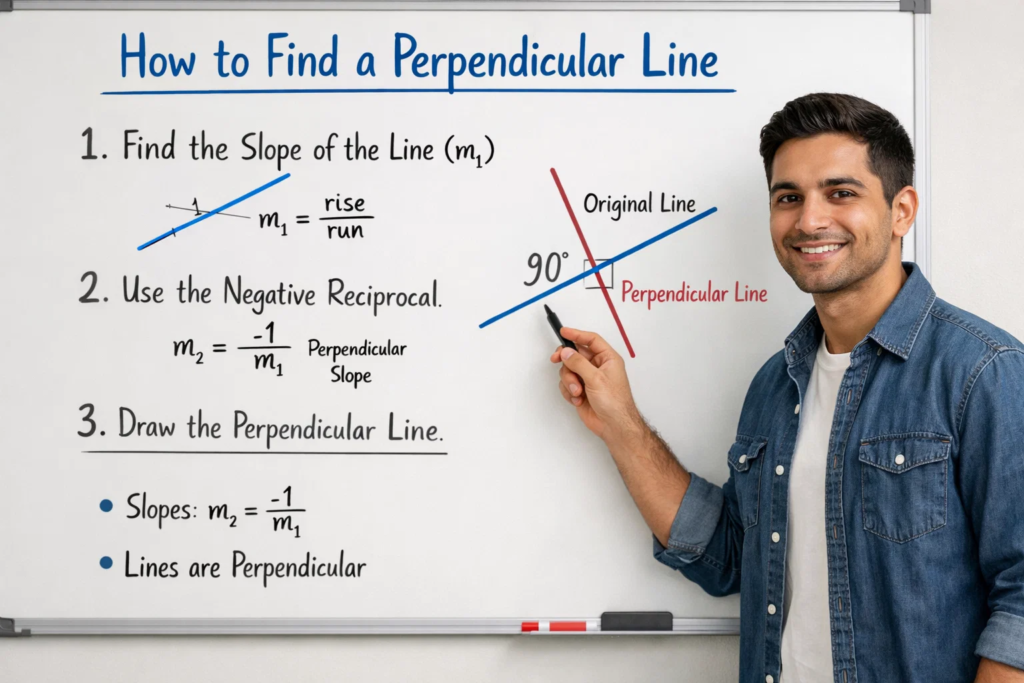
How to find a perpendicular line? The introduction of coordinate geometry by René Descartes revolutionized the way perpendicular lines are calculated. Instead of relying only on visual angles, mathematicians began using slopes and equations to determine relationships between lines. The slope measures how steep a line is and is calculated using the formula m = (y₂ − y₁) / (x₂ − x₁). When two lines are perpendicular, their slopes have a special mathematical relationship. This relationship allows you to find the slope of a perpendicular line instantly without measuring angles. Coordinate geometry makes calculations precise, efficient, and applicable in modern technology, including computer graphics, physics simulations, and engineering designs.
The Negative Reciprocal Rule Explained
The most important rule for determining perpendicular lines is the negative reciprocal rule. If one line has slope m, the perpendicular line will have slope −1/m. This means you flip the fraction and change the sign. How to find a perpendicular line? For example, if a line has slope 2, the perpendicular slope becomes −1/2. If the slope is 3/4, the perpendicular slope becomes −4/3. This rule works because perpendicular lines must balance each other’s direction and steepness to form a perfect right angle. This mathematical relationship makes it simple to determine perpendicular lines without measuring angles directly, which is especially useful in algebra and coordinate-based problem solving.
Why the Negative Reciprocal Rule Works
The negative reciprocal rule works because of the mathematical properties of angles and slopes. When two lines intersect at 90 degrees, their slopes multiply to equal −1. This unique relationship ensures the lines meet perfectly at a right angle. For example, if slope one is 5, slope two must be −1/5, because their product equals −1. This balance guarantees perpendicularity. This rule applies universally in coordinate geometry, regardless of the line’s position or orientation. Understanding how to find a perpendicular line this principle provides a reliable method for determining perpendicular lines in equations, graphs, and real-world applications.
How to Find a Perpendicular Line from an Equation
How to find a perpendicular line? When you are given an equation, the process involves identifying the slope and applying the negative reciprocal rule. First, convert the equation into slope-intercept form, which is y = mx + b. In this equation, m represents the slope. Once you identify the slope, calculate its negative reciprocal. This new value becomes the slope of the perpendicular line. After finding the new slope, you can use it to write a new equation. This method is widely used in algebra and helps solve problems involving line relationships, intersections, and graph analysis efficiently.
Example: Finding a Perpendicular Line from y = 3x + 2
In this example, the slope of the given line is 3. To find the perpendicular slope, take the negative reciprocal, which becomes −1/3. This new slope represents any line perpendicular to the original line. If you need to write a full equation, you must also know a point that the perpendicular line passes through. How to find a perpendicular line? Once you have the point and slope, you can use the point-slope formula to write the equation. This example demonstrates how simple and efficient it is to determine perpendicular relationships using algebraic formulas.
Example: Finding a Perpendicular Line from Standard Form
Sometimes equations are written in standard form, such as Ax + By = C. To find the slope, rearrange the equation into slope-intercept form. How to find a perpendicular line? For example, if the equation is 2x + y = 5, rewrite it as y = −2x + 5. The slope is −2, so the perpendicular slope becomes 1/2. This transformation allows you to easily calculate perpendicular lines regardless of the original equation format. This method is especially useful in exam questions and advanced algebra problems where equations are not always presented in slope-intercept form.
How to Find a Perpendicular Line Through a Specific Point
Often, you will need to find a perpendicular line that passes through a specific point. In this case, use the point-slope formula, which is y − y₁ = m(x − x₁). First, find the perpendicular slope using the negative reciprocal rule. Then substitute the coordinates of the given point into the formula. This creates an equation that represents the perpendicular line passing through that exact location. How to find a perpendicular line this method ensures accuracy and allows you to solve real-world problems involving coordinate positioning, navigation, and engineering design.
Constructing Perpendicular Lines Without Coordinates
How to find a perpendicular line? Perpendicular lines can also be constructed using geometric tools such as a compass and straightedge. This method is commonly taught in classical geometry. First, draw the original line and mark the point where you want the perpendicular line to pass. Next, use the compass to draw arcs on both sides of the point. Then draw intersecting arcs above and below the line. Finally, connect the intersection points with a straightedge. This new line will be perpendicular to the original line. How to find a perpendicular line? This construction method is exact and demonstrates the geometric principles that mathematicians have used for centuries.
Real-Life Applications of Perpendicular Lines
How to find a perpendicular line? Perpendicular lines play a crucial role in real-world structures and technologies. In architecture, walls and floors must meet at 90 degrees to ensure stability and safety. Engineers rely on perpendicular relationships when designing bridges, buildings, and machinery. In navigation, maps use perpendicular grid systems to represent locations accurately. Computer graphics also use perpendicular calculations to render realistic images and animations. Without perpendicular relationships, modern engineering and digital technology would not function correctly. Understanding how to find a perpendicular line this concept connects mathematics to everyday life and practical applications.
Common Mistakes and How to Avoid Them
How to find a perpendicular line? One common mistake is forgetting to change the sign when calculating the negative reciprocal. For example, the reciprocal of 2 is 1/2, but the perpendicular slope must be −1/2, not positive. Another mistake is confusing reciprocal and negative reciprocal. Both steps are necessary. Students also sometimes forget to convert equations into slope-intercept form before identifying the slope. To avoid errors, how to find a perpendicular line always follow a step-by-step process: identify the slope, flip the fraction, change the sign, and use the correct formula. Practicing regularly helps improve accuracy and confidence.
Practical Tips and Memory Tricks
A helpful trick to remember perpendicular slopes is the phrase “flip and change the sign.” This simple reminder ensures you apply both parts of the negative reciprocal rule correctly. Another useful strategy is to practice graphing perpendicular lines to visualize the relationship. Seeing how lines intersect at 90 degrees reinforces understanding. How to find a perpendicular line? Using graph paper or digital graphing tools can make learning easier and more interactive. With consistent practice, identifying perpendicular relationships becomes automatic and intuitive.
Conclusion
Learning how to find a perpendicular line is a fundamental skill that connects geometry, algebra, and real-world applications. From ancient geometry to modern engineering, perpendicular relationships ensure accuracy, stability, and balance. By understanding how to find a perpendicular line, slopes, negative reciprocals, and equation formulas, you can easily identify perpendicular lines in any situation. Whether working with graphs, equations, or geometric constructions, the process remains consistent and reliable. Mastering this concept strengthens mathematical reasoning and prepares you for advanced topics in science, engineering, and technology. With practice and careful application of the rules, finding perpendicular lines becomes simple, logical, and highly useful in both academic and practical settings.
FAQs
What is the easiest way to determine if two lines are perpendicular?
The easiest way is to compare their slopes. If the slope of one line is the negative reciprocal of the other, the lines are perpendicular. For example, if one slope is 4, the perpendicular slope must be −1/4. This relationship ensures the lines intersect at exactly 90 degrees. You do not need to measure angles manually when using slope calculations. This method is fast, accurate, and widely used in algebra and coordinate geometry problems. Always remember to flip the fraction and change the sign to determine perpendicular slopes correctly.
Can perpendicular lines exist without intersecting?
In geometry, perpendicular lines must intersect to form a 90-degree angle. If two lines never meet, they cannot form perpendicular angles. However, line segments or rays can be extended infinitely in mathematics, and when extended, perpendicular relationships become visible. In coordinate geometry, perpendicular lines always intersect at some point unless they exist in separate planes. This concept is especially important in three-dimensional geometry, where perpendicular relationships may occur between planes rather than simple lines.
Why is the negative reciprocal used for perpendicular slopes?
The negative reciprocal ensures the slopes multiply to equal −1, which mathematically defines perpendicular lines. This rule comes from trigonometric and geometric principles that govern right angles. Without using the negative reciprocal, the lines would not form a perfect 90-degree intersection. This rule applies to all straight lines in coordinate geometry and is one of the most reliable tools for determining perpendicular relationships. Understanding this principle allows students and professionals to solve problems efficiently and accurately.
How do you find a perpendicular line through a point?
First, identify the slope of the original line. Then calculate the negative reciprocal to get the perpendicular slope. Next, use the point-slope formula and substitute the coordinates of the given point. This creates an equation representing the perpendicular line passing through that exact point. This method is commonly used in algebra, physics, and engineering. It ensures precise positioning and accurate calculations in coordinate systems.
Are horizontal and vertical lines perpendicular?
Yes, horizontal and vertical lines are always perpendicular. A horizontal line has a slope of 0, while a vertical line has an undefined slope. These two types of lines intersect at exactly 90 degrees, forming perfect right angles. This relationship is visible in coordinate grids, where vertical and horizontal axes meet at the origin. This is one of the simplest and most recognizable examples of perpendicular lines.
Why are perpendicular lines important in real life?
Perpendicular lines ensure structural stability and accurate measurements in construction, engineering, and design. Buildings rely on perpendicular walls and floors for balance and safety. Navigation systems use perpendicular grids to locate positions accurately. Computer graphics depend on perpendicular calculations to create realistic images. This concept is essential for maintaining order, precision, and functionality in modern technology and infrastructure.
For More Update and Stories Visit Daily Guides