 Admin
Admin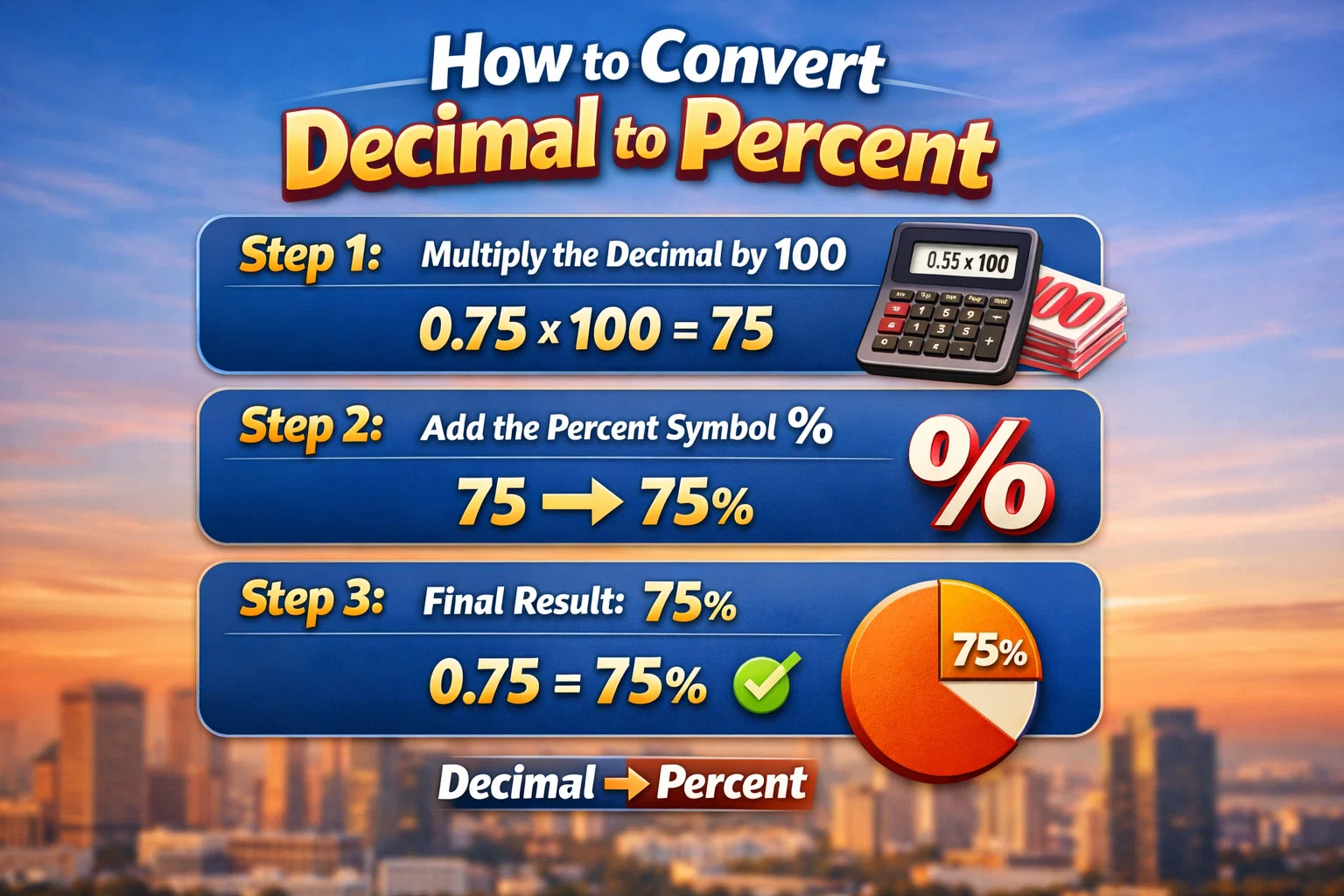
Understanding percentages is essential in everyday life, whether you’re calculating discounts, analyzing data, or interpreting statistics. One of the most common tasks in math is converting decimals to percent. Knowing how to convert decimal to percent helps in academics, finance, and professional settings, making numbers more relatable and understandable.
Decimals and percentages are two ways to represent the same value. A decimal is a fraction expressed in base 10, like 0.75, while a percentage represents parts per hundred, such as 75%. Converting between these forms allows for easier comparison, visualization, and calculation. This guide provides step-by-step methods, practical examples, and advanced tips for converting decimals to percentages accurately.
What Is a Decimal and What Is a Percent?
Before learning how to convert decimal to percent, it’s important to understand their meanings. A decimal is a number that includes a fractional part separated by a decimal point, representing values less than one or greater. For example, 0.25 represents twenty-five hundredths.
A percent, on the other hand, expresses a number as a fraction of 100. The symbol “%” denotes this. For instance, 25% means 25 out of 100. Converting decimals to percent involves translating the base-10 fraction into a parts-per-hundred format, making it easier to grasp proportions, compare values, and communicate results effectively in various contexts.
Why Converting Decimals to Percent Is Useful
Converting decimals to percentages is useful in multiple real-life situations. In finance, it helps calculate interest rates, investment returns, or tax values. In education, teachers and students often use percentages to interpret grades, scores, and statistical data.
Percentages are easier for most people to understand how to convert decimal to percent, because they relate values to a familiar base of 100. For example, 0.8 may not immediately convey magnitude, but 80% gives a clear sense of proportion. In professional environments, using percentages improves reporting, presentations, and decision-making. Mastery of this conversion is a critical skill in both academic and practical contexts.
The Basic Method to Convert Decimal to Percent
The most straightforward method to convert a decimal to a percent is to multiply the decimal by 100 and add the percent symbol (%). This method works for all decimal values, positive or negative.
For example, to convert 0.45 to a percent:
0.45 × 100 = 45 → 45%
Similarly, 0.032 × 100 = 3.2 → 3.2%
This method is reliable, quick, and simple. It also highlights the mathematical relationship between decimals and percentages, reinforcing understanding how to convert decimal to percent of proportions and scaling in numerical analysis.
Step-by-Step Conversion with Examples
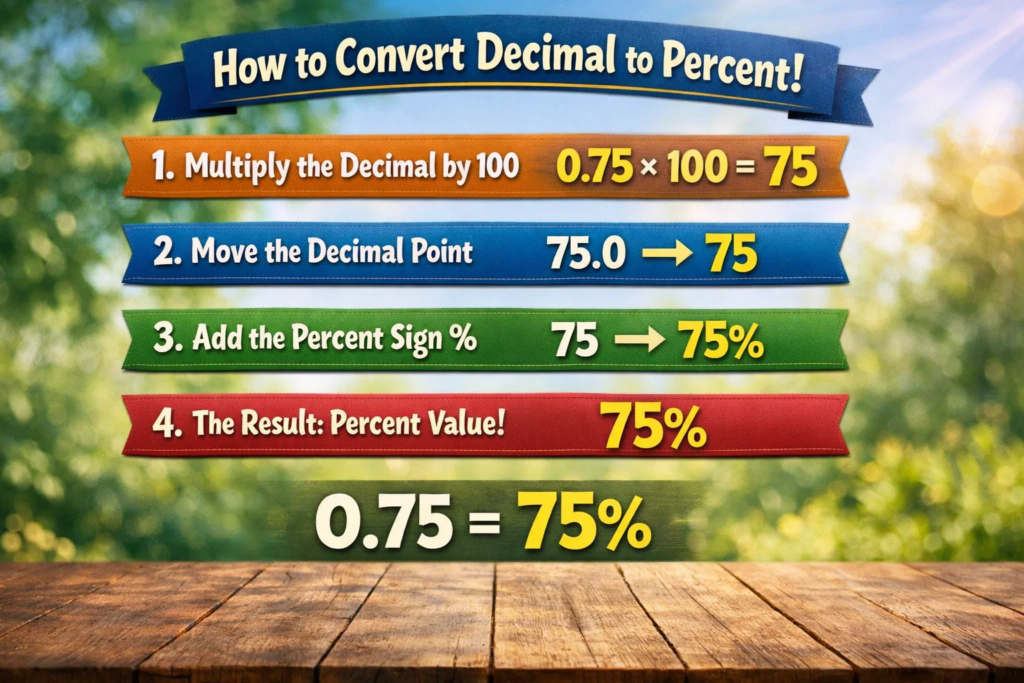
Step 1: Identify the decimal number you want to convert.
Step 2: Multiply the decimal by 100.
Step 3: Attach the percent symbol (%) to the resulting number.
For example: Convert 0.875 to a percent.
Step 1: Decimal = 0.875
Step 2: Multiply by 100 → 0.875 × 100 = 87.5
Step 3: Add % → 87.5%
How to convert decimal to percent? This approach can be applied to both small and large decimals. It’s useful in classrooms, exams, and financial calculations where precise percentages are required.
Converting Negative Decimals to Percent
Negative decimals represent values below zero. Converting them to percent follows the same principle as positive decimals. Multiply the negative decimal by 100 and add the percent symbol.
For example, -0.6 × 100 = -60 → -60%
How to convert decimal to percent? This method is essential in finance and economics, where negative percentages indicate losses, decreases, or deficits. Understanding how to handle negative decimals ensures clarity in data representation and prevents misinterpretation in reports and analyses.
Converting Repeating Decimals to Percent
Repeating decimals, like 0.333…, require careful conversion. Multiply the repeating decimal by 100 and round if necessary.
For example: 0.666… × 100 = 66.6%
How to convert decimal to percent? Repeating decimals often appear in statistical calculations, probabilities, or fractions that cannot be expressed as finite decimals. Converting them to percentages makes data easier to interpret while maintaining an appropriate level of precision for reporting or analysis.
Using Fraction Conversion to Percent
Another method involves converting a decimal to a fraction first, then to a percent. For instance, 0.75 as a fraction is 75/100. From there, it’s straightforward to write 75/100 as 75%.
How to convert decimal to percent? This method helps students who are more comfortable with fractions or who encounter decimals derived from fractional values. It also reinforces the concept that decimals, fractions, and percentages are different representations of the same quantity.
Converting Percent Back to Decimal
Understanding how to convert decimal to percent the reverse process is equally important. To convert a percent to a decimal, divide the percentage by 100 and remove the percent symbol.
Example: 45% ÷ 100 = 0.45
This skill is critical in algebra, finance, and science, where calculations often require converting percentages into decimals before performing multiplication, division, or other operations. Knowing both directions enhances numerical fluency.
Practical Applications of Decimal to Percent Conversion
Decimal-to-percent conversion is widely used in daily life. For example, when calculating sales tax, a decimal rate like 0.07 translates to 7%. In finance, interest rates and investment returns are often expressed in decimal form in formulas but communicated as percentages for clarity.
In health and science, percentages are used to represent probabilities, concentrations, and statistical results. Mastering conversion ensures accuracy in measurements, reporting, and decision-making. Even in casual contexts like discounts or exam scores, understanding how to convert decimal to percent this conversion is practical and valuable.
Using Technology for Decimal to Percent Conversion
Digital tools simplify conversion. Spreadsheet software like Microsoft Excel or Google Sheets can automatically convert decimals to percentages with formatting functions. For example, in Excel, entering 0.25 in a cell and formatting it as a percent displays 25%.
Online calculators and mobile apps provide instant conversions, especially for complex decimals or repeating values. While manual calculation builds fundamental understanding how to convert decimal to percent, using technology saves time and ensures accuracy, particularly for professionals handling large datasets or statistical analyses.
Common Mistakes to Avoid
While converting decimals to percentages is simple, some common errors occur. A frequent mistake is forgetting to multiply by 100, leading to a number that is 100 times smaller than the correct percent. Another error is omitting the percent symbol, which can confuse readers or imply a decimal value instead of a percentage.
How to convert decimal to percent? Rounding incorrectly or misplacing decimal points also causes inaccuracies, especially in finance or scientific calculations. Careful attention to multiplication, symbol placement, and rounding ensures that conversions are precise and reliable.
Tips for Quick Mental Conversion
Quick mental conversion is useful for estimates and everyday calculations. Multiply decimals by 100 in your head. For instance, 0.4 → 40%, 0.05 → 5%, 0.125 → 12.5%.
Recognizing common decimal-percent equivalents improves speed. For example, 0.25 → 25%, 0.5 → 50%, 0.75 → 75%. How to convert decimal to percent? This mental agility is valuable in exams, shopping, and professional settings where fast estimation is required without paper or calculators.
Converting Large and Small Decimals
Large decimals like 12.34 convert easily: 12.34 × 100 = 1234%. Small decimals like 0.0032 → 0.0032 × 100 = 0.32%.
Understanding how to convert decimal to percent scale is important. Percentages greater than 100% indicate values exceeding the whole, while percentages below 1% represent small proportions. Correct interpretation ensures accurate communication and avoids misrepresentation in financial reports, statistics, or scientific data.
Rounding and Precision in Percentages
Precision matters when converting decimals to percent. Often, percentages are rounded to one or two decimal places for clarity. For example, 0.567 → 56.7%.
In finance, rounding errors can lead to significant discrepancies, so proper attention to decimal places is essential. In academic or technical contexts, follow guidelines on significant figures or decimal limits to maintain consistency and accuracy.
Teaching Strategies for Students
When teaching how to convert decimal to percent, use real-world examples. Show students that 0.25 as 25% represents a quarter of a pizza or a 25% discount. Visual aids, interactive worksheets, and digital tools enhance comprehension.
Encourage practice with positive, negative, repeating, and large decimals. Gradually introduce reverse conversions to reinforce understanding. Using contextual examples ensures students grasp the practical importance of decimal-to-percent conversion.
Conclusion
Learning how to convert decimal to percent is an essential skill for students, professionals, and anyone working with numbers. Multiplying decimals by 100 and adding the percent symbol is the foundation, but understanding rounding, negative values, repeating decimals, and real-world applications enhances proficiency.
Mastery of this skill improves clarity in communication, accuracy in calculations, and confidence in mathematical reasoning. Whether manually calculating, using fractions, or leveraging digital tools, converting decimals to percentages makes data more intuitive and actionable in everyday life, education, and professional contexts.
Frequently Asked Questions
1. How do I convert 0.45 to a percent?
Multiply 0.45 by 100 → 45%, then add the percent symbol.
2. Can negative decimals be converted to percent?
Yes, for example, -0.6 × 100 = -60%.
3. How do I convert repeating decimals to percent?
Multiply the repeating decimal by 100 and round appropriately, e.g., 0.333… → 33.3%.
4. Can I convert a decimal greater than 1 to percent?
Yes, 1.2 × 100 = 120%. Percentages over 100% indicate values exceeding the whole.
5. How do I convert a percent back to a decimal?
Divide the percent by 100 and remove the symbol, e.g., 25% → 0.25.
6. Is there a shortcut for mental conversion?
Yes, move the decimal point two places to the right and add %, e.g., 0.08 → 8%.
7. Why is rounding important when converting decimals?
Rounding ensures clarity and prevents minor errors in finance, statistics, and reporting.
For More Update and Stories Visit Daily Guides