 Admin
Admin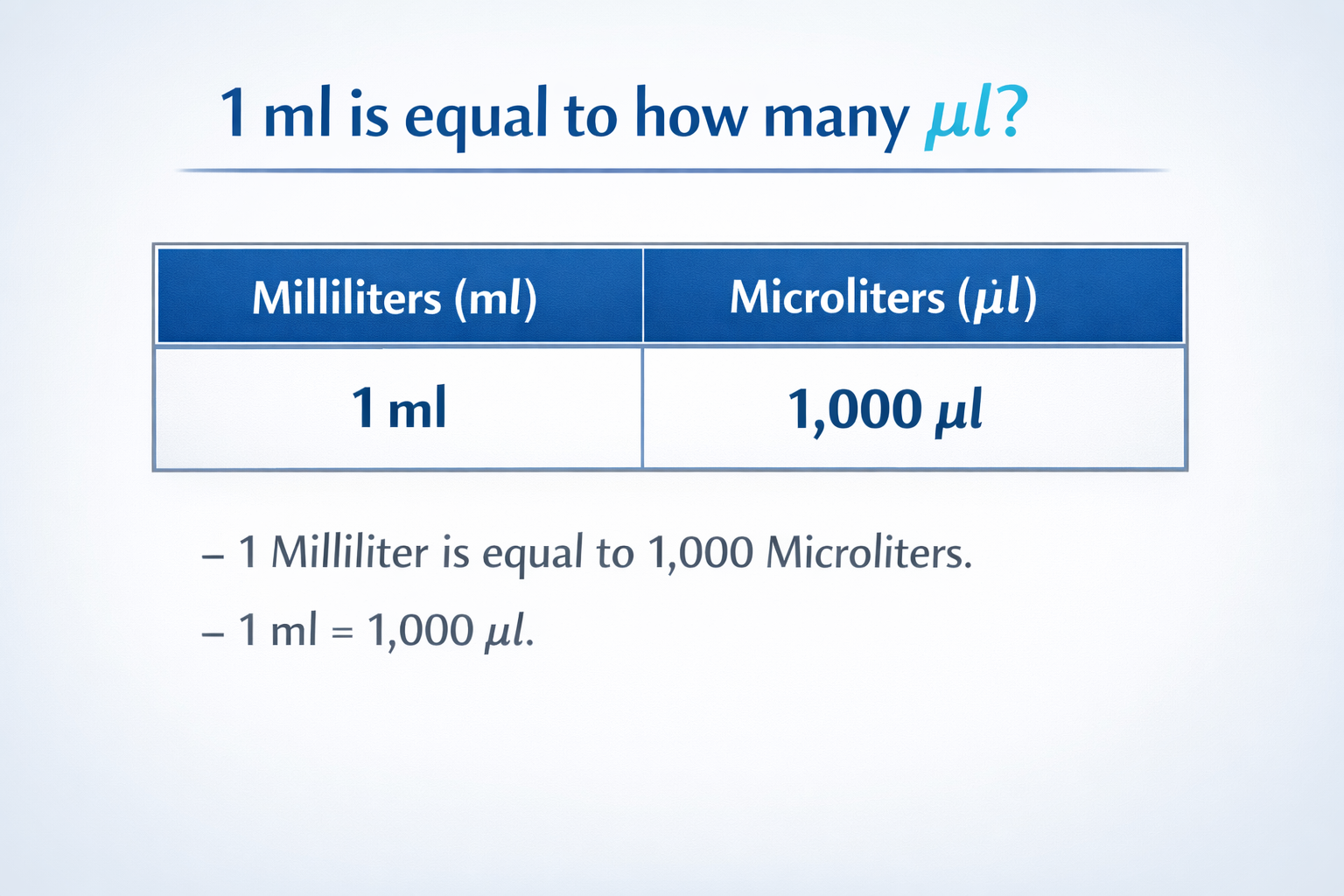
Understanding unit conversions is essential in science, medicine, education, and daily measurements. One of the most commonly asked questions is 1 mL is equal to how many uL. This confusion usually arises because milliliters and microliters are both used to measure volume but at very different scales. Whether you are a student, lab technician, healthcare worker, or someone dealing with precise liquid measurements, knowing this conversion ensures accuracy and safety. This article explains the relationship between these units, how the metric system works, where this conversion is used, and why precision matters in real-life situations.
Understanding the Metric System Basics
The metric system is a globally accepted system of measurement based on powers of ten. It is designed to make calculations simple and consistent across scientific and everyday applications. Units like meters, liters, and grams form the foundation of this system. Prefixes such as milli and micro indicate fractions of the base unit. Because the system is decimal-based, converting between units only requires multiplication or division by factors of ten. This simplicity is one reason the metric system is widely used in laboratories, hospitals, and educational institutions around the world.
What Is a Milliliter (mL)?
A milliliter (mL) is a unit of volume equal to one-thousandth of a liter. It is commonly used to measure small amounts of liquids such as water, medicine, chemicals, and beverages. In healthcare, milliliters are used to measure liquid medications accurately. In cooking, they help maintain consistent recipes. Because milliliters represent a manageable and practical volume, they are widely used in daily life as well as professional environments that require moderate precision.
What Is a Microliter (uL)?
A microliter (uL) is a much smaller unit of volume, equal to one-millionth of a liter. It is primarily used in scientific and medical settings where extremely small liquid quantities must be measured accurately. Laboratories, research facilities, and diagnostic centers rely on microliters when working with blood samples, DNA solutions, enzymes, and reagents. Because microliters represent such tiny volumes, specialized instruments like micropipettes are required for accurate measurement.
1 mL Is Equal to How Many uL? The Simple Answer
The conversion between these two units is straightforward. 1 milliliter equals 1000 microliters. This means that when you convert from milliliters to microliters, you multiply by 1000. Conversely, when converting from microliters to milliliters, you divide by 1000. This relationship is fixed and universal within the metric system. Understanding this simple conversion removes confusion and ensures accuracy in calculations involving small volumes of liquid.
Why This Conversion Is Important
Accurate volume conversion is crucial in many fields. In medicine, incorrect measurement can lead to underdosing or overdosing, which may have serious consequences. In laboratories, even minor measurement errors can compromise experimental results. Educational settings also rely on accurate conversions to teach scientific concepts properly. Knowing how to convert milliliters to microliters builds confidence and prevents mistakes that could affect health, research outcomes, or academic performance.
The Mathematical Logic Behind the Conversion
The conversion is based on metric prefixes. The prefix milli represents one-thousandth, while micro represents one-millionth. Since one milliliter is one-thousandth of a liter and one microliter is one-millionth of a liter, the relationship becomes clear. Dividing one-thousandth by one-millionth results in 1000. This mathematical consistency makes the metric system logical and reliable for precise measurements.
How to Convert mL to µL Step by Step
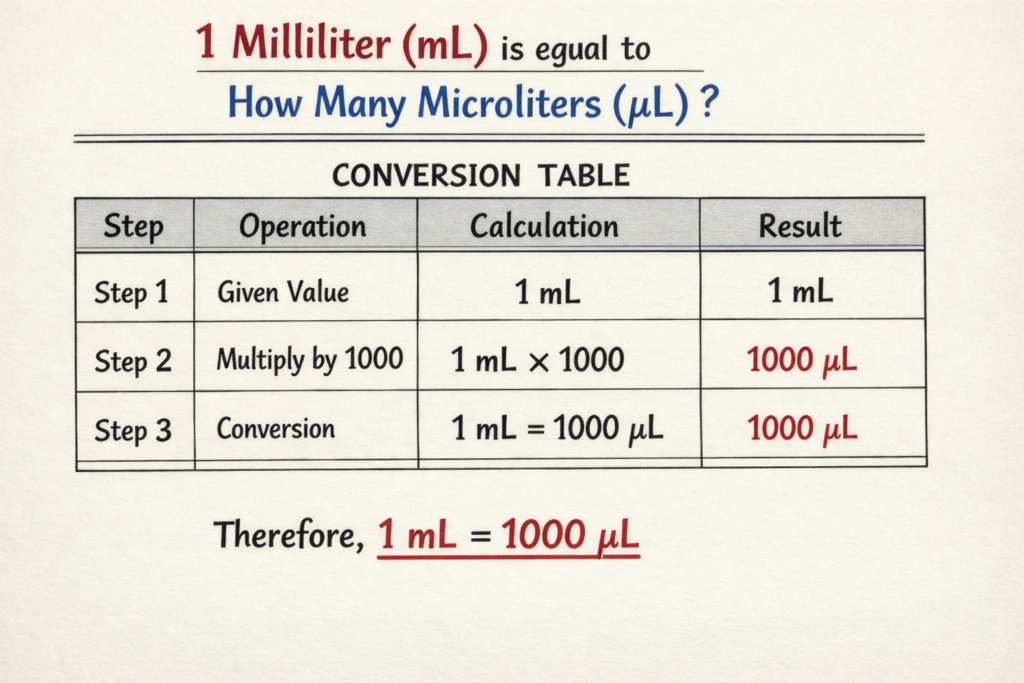
1 mL is equal to how many uL. To convert milliliters to microliters, follow a simple process. First, identify the value in milliliters. Next, multiply that value by 1000. For example, 2 mL becomes 2000 uL, and 0.5 mL becomes 500 uL. This method works for any value and requires no complex calculations. Memorizing this single rule saves time and reduces the risk of error.
Common Real-Life Examples of the Conversion
1 mL is equal to how many uL. In a medical setting, a syringe marked in milliliters may need to deliver a dose calculated in microliters. In a laboratory, a solution prepared in milliliters might need to be divided into microliter portions. Even in education, students regularly convert between these units during experiments. These practical examples show why understanding the conversion is not just theoretical but directly applicable to real-world tasks.
Use in Medical and Healthcare Settings
1 mL is equal to how many uL. Healthcare professionals frequently deal with liquid medications that require precise dosing. Neonatal care, injections, and intravenous solutions often involve microliter-level accuracy. Nurses and pharmacists rely on correct conversions to ensure patient safety. A simple misunderstanding between milliliters and microliters could result in a thousand-fold error, highlighting the importance of mastering this basic measurement concept.
Importance in Laboratory and Research Work
1 mL is equal to how many uL. Scientific research depends on precision. Many experiments involve reagents measured in microliters because even small variations can affect outcomes. Researchers use calibrated micropipettes to handle these volumes. Knowing the relationship between milliliters and microliters helps scientists prepare solutions accurately and maintain experimental consistency. This foundational knowledge supports reliable data and reproducible results.
Educational Significance of the Conversion
1 mL is equal to how many uL. Students studying biology, chemistry, and physics encounter volume conversions early in their education. Learning how to convert between milliliters and microliters builds a strong foundation for more advanced scientific concepts. Teachers emphasize this conversion because it reinforces understanding of metric prefixes and unit relationships. Mastery at this level simplifies future learning and improves overall scientific literacy.
Common Mistakes People Make
1 mL is equal to how many uL. One common mistake is confusing microliters with milliliters due to their similar names. Another error involves misplacing zeros during conversion, leading to incorrect values. Some people assume the conversion is arbitrary rather than fixed. These mistakes can be avoided by remembering that the metric system is based on powers of ten and that one milliliter always equals one thousand microliters.
Tools Used to Measure mL and uL
1 mL is equal to how many uL. Different tools are designed for different volume ranges. Measuring cylinders and syringes are typically used for milliliters. Micropipettes and micro-syringes are used for microliters. Each instrument is calibrated for accuracy within its range. Using the correct tool ensures reliable measurements and prevents damage to equipment or errors in results.
Why Precision Matters in Small Measurements
1 mL is equal to how many uL. As measurements become smaller, the margin for error decreases. A tiny mistake in microliter measurements can have a large impact, especially in medicine and research. Precision ensures safety, accuracy, and reliability. Understanding unit conversions helps professionals maintain control over these small but critical quantities.
Everyday Understanding Made Simple
1 mL is equal to how many uL. Although microliters are rarely used in daily household activities, understanding them improves overall numerical and scientific awareness. It helps people read medication labels, understand health information, and interpret scientific data. This knowledge empowers individuals to make informed decisions and communicate more effectively with professionals.
Metric System Advantages Over Other Systems
1 mL is equal to how many uL. The metric system’s simplicity makes conversions like this easy. Unlike other systems that rely on irregular conversion factors, the metric system uses consistent multiples of ten. This design reduces confusion and calculation time. It is one reason why science and medicine worldwide rely almost exclusively on metric units.
Quick Memory Tip for Easy Recall
1 mL is equal to how many uL. A simple way to remember the conversion is to associate milli with thousand and micro with million. Since a thousand is larger than a millionth, one milliliter must contain one thousand microliters. This mental association makes recall fast and reliable.
Conclusion
1 mL is equal to how many uL. Understanding 1 mL is equal to how many uL is a fundamental skill in science, healthcare, and education. The correct conversion is simple: 1 milliliter equals 1000 microliters. This knowledge ensures accuracy, prevents serious errors, and builds confidence in handling liquid measurements. By understanding the logic behind the metric system and practicing conversions, anyone can master this essential concept. Precision begins with understanding, and this conversion is a key step toward accurate measurement.
Frequently Asked Questions (FAQs)
1. How many microliters are in 1 milliliter?
There are 1000 microliters in 1 milliliter.
2. Why is the conversion always the same?
Because the metric system uses fixed powers of ten.
3. Is µL smaller than mL?
Yes, a microliter is much smaller than a milliliter.
4. Where is this conversion commonly used?
It is widely used in laboratories, hospitals, and scientific education.
5. How do I convert mL to uL quickly?
Multiply the number of milliliters by 1000.
6. Can mistakes in this conversion be dangerous?
Yes, especially in medical and laboratory settings.
7. Do I need special tools to measure microliters?
Yes, micropipettes or micro-syringes are used for accuracy.
For More Update and Stories Visit Daily Guides